Hose reinforcement density: extrusion, knitting and braiding explained
High or low longitudinal density is not a setting on the extruder. It is a property of the reinforcement layer. To specify it usefully, separate what the extrusion line controls from what the knitting or braiding machine controls.
Three processes, three different jobs
An extruded rubber tube sets the bore, wall and compound. A knitted or braided layer adds strength, shape control and resistance to pressure or abrasion. The three processes interact, but they do not control the same variables.
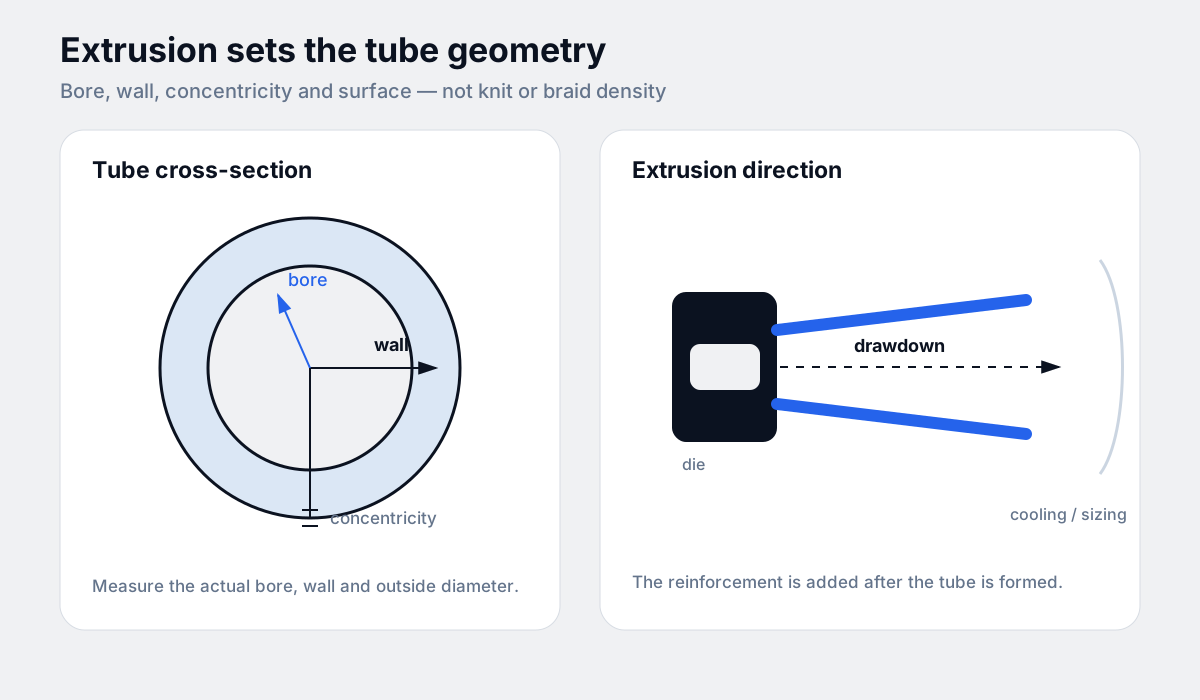
- Extrusion: bore, wall thickness, concentricity, surface and compound distribution.
- Knitting: loop structure, needle count, courses per unit length and flexibility.
- Braiding: carrier count, yarn path, braid angle and coverage.
What “high” and “low” longitudinal density mean
In a reinforced hose, longitudinal density describes how much reinforcement is packed along the hose axis. It is often expressed as courses per unit length for a knit, or as braid pitch and coverage for a braid. Transverse density describes how many wales or yarn paths run around the circumference.
The words “high” and “low” are only useful when the unit and direction are stated. A dense knit along the length is not the same as a high needle count around the circumference, and neither one alone tells you the pressure rating of the finished hose.
Extrusion sets the tube, not the knit density
The extruder controls the unvulcanised tube: bore, wall, concentricity and surface. Die design, line speed, drawdown and cooling affect the tube and the way the compound is oriented. They do not set the number of needles in a knitting machine or the number of carriers on a braider.
If a specification says “high longitudinal density” but only describes the extruder, the requirement is incomplete. State whether the density belongs to the knit, the braid, or the finished hose, and give the direction of measurement.
Knitting: needle count and longitudinal density
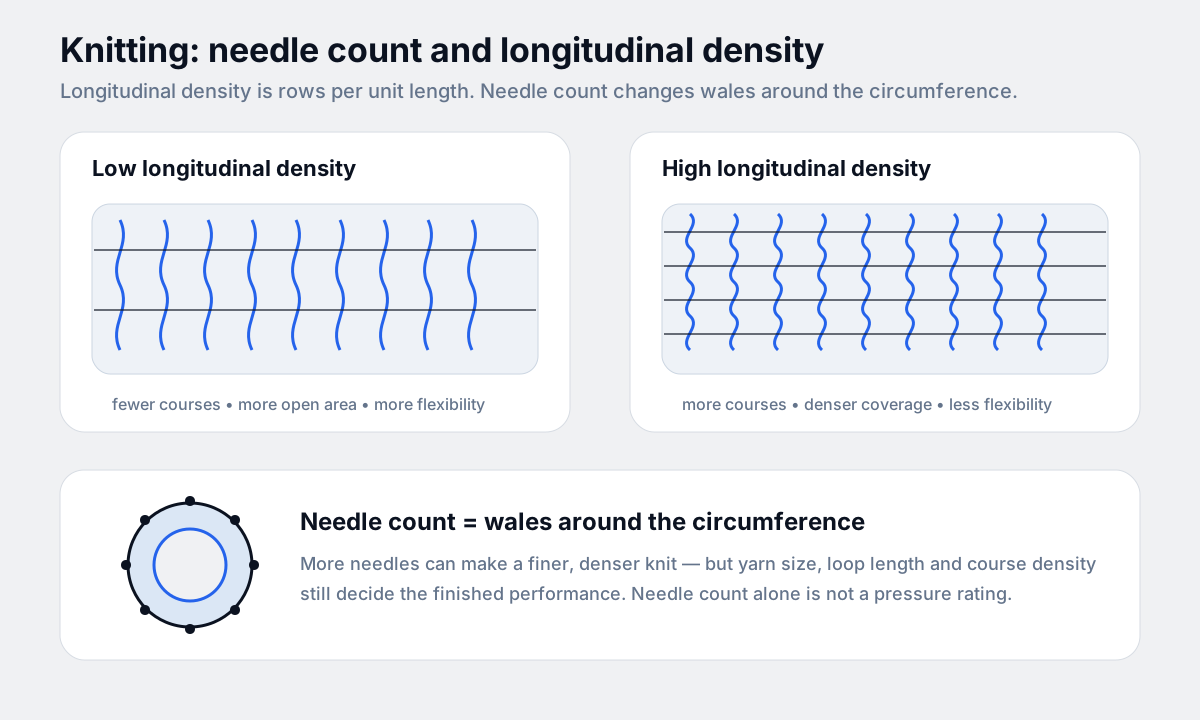
Needle count is the number of needles around the knitting cylinder. It sets the number of wales around the hose and therefore the range of diameters the machine can cover efficiently. More needles can give a finer, denser structure around the circumference, but the result also depends on yarn size, loop length, course density and the mandrel diameter.
Longitudinal density is controlled mainly by courses per unit length: how closely the rows of loops follow one another along the hose. A higher course density can improve coverage and shape support, but it can also reduce flexibility, increase weight and slow production. A lower density may be more flexible, but it may leave more open area and less support under pressure.
Needle count alone is not a pressure rating. Two knits with the same needle count can behave differently if the yarn, loop length or course density changes.
Braiding: carrier count, angle and coverage
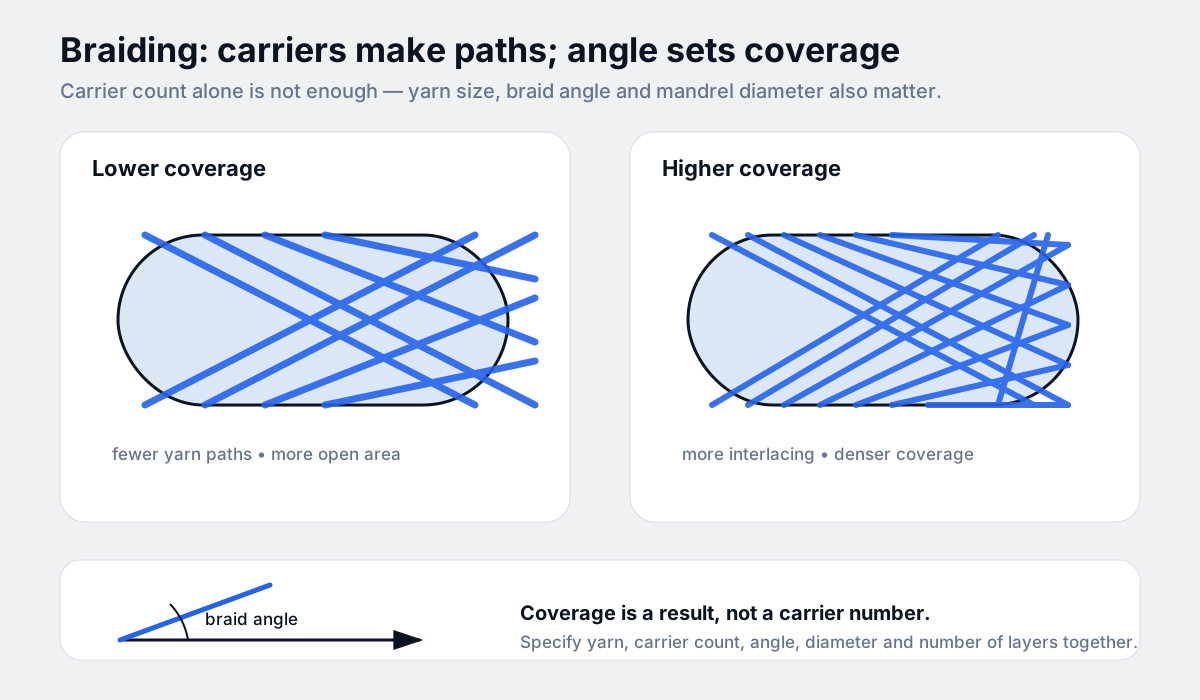
On a braider, the carrier count is the number of yarn packages moving around the mandrel. It affects how many yarn paths cross in the braid and how much coverage the layer can produce. A higher carrier count can support a denser or more interlaced structure, but the final result also depends on yarn size, braid angle, mandrel diameter and the number of layers.
Braid angle matters as much as carrier count. A steeper angle changes coverage, elongation and how the reinforcement responds to pressure; a shallower angle changes the same properties in the other direction. Carrier count without angle and yarn specification is not enough to compare two constructions.
More reinforcement is not automatically better. It can improve pressure resistance or abrasion resistance, but it can also reduce flexibility, add weight and cost, and make assembly harder. The right density is the one that meets the service condition without overbuilding the part.
How to specify reinforcement without guessing
Send the hose drawing or sample and state the construction you are trying to match. The useful specification includes:
- Hose bore and wall thickness, with the actual outside diameter if available.
- Reinforcement type: knit, braid, spiral or a combination.
- Direction of density: longitudinal, transverse or both.
- Needle count or carrier count only if it is already fixed by the existing part.
- Yarn type, count and construction, if known.
- Working pressure, peak pressure and vacuum.
- Temperature, fluid and service life.
- Flexibility, bend radius and assembly method.
Where a number is not fixed, confirm it against the sample or drawing. Do not copy a needle or carrier count from a different hose diameter and assume the coverage will be the same. For the wider failure picture, see why hoses fail.
Bottom line: specify the layer, not just the machine
Extrusion, knitting and braiding are often discussed together because they run one after another, but they answer different questions. Extrusion sets the tube. Knitting and braiding set the reinforcement. The density you need is a result of the yarn, the machine setup and the service condition — not a single number on a control panel.
| Process | Main variables | What it does not tell you |
|---|---|---|
| Extrusion | Bore, wall, concentricity, compound, drawdown and cooling | Knit course density or braider carrier count |
| Knitting | Needle count, wales, courses per unit length, yarn and loop length | Pressure rating on its own |
| Braiding | Carrier count, braid angle, yarn size, mandrel diameter and number of layers | Coverage on a different diameter without re-checking |
If you only remember one thing: state the direction and unit of the density, name the reinforcement process, and send the sample or drawing. That gives a factory enough information to match the construction instead of guessing from a needle or carrier count.
Send a drawing, a photo with a ruler, or the old sample. We will confirm the hose, reinforcement and density direction before quoting.